
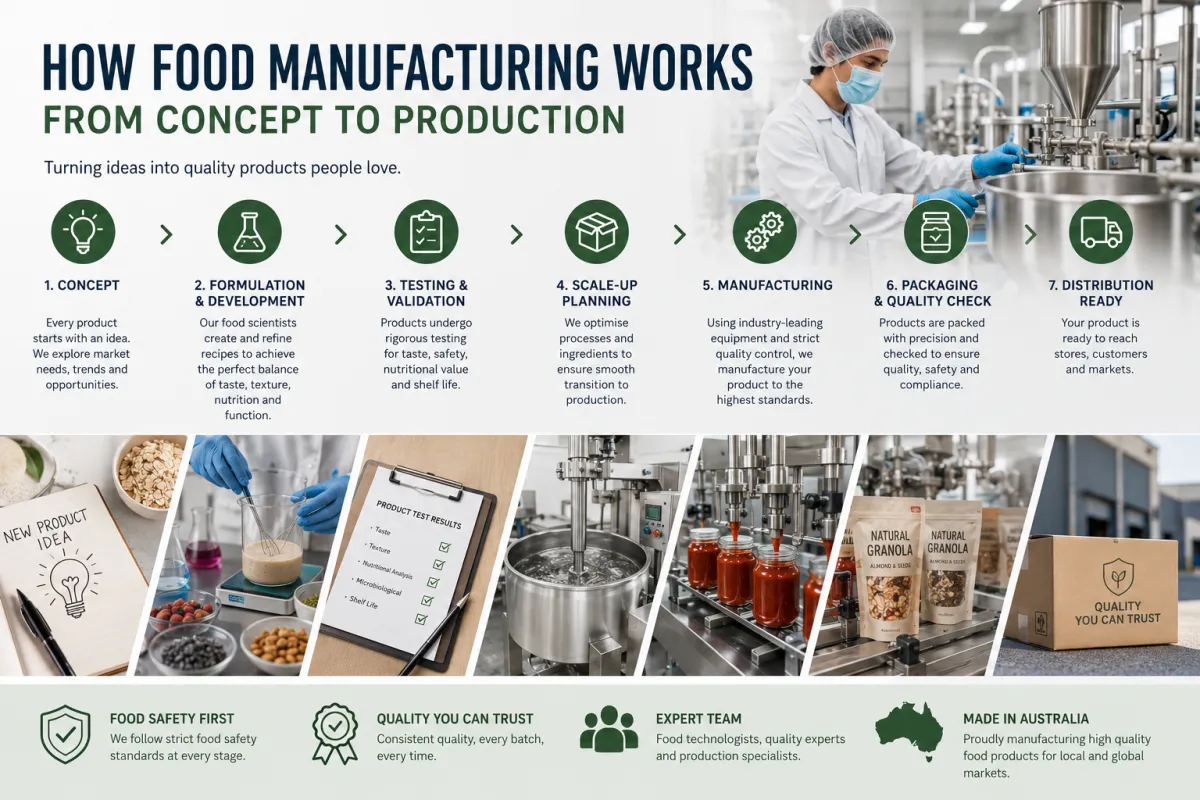
How Food Manufacturing Works from Concept to Production
Every successful food product begins with an idea.
It might start with a recipe developed in a home kitchen, a gap identified in the market, a new health trend or a simple observation that consumers are looking for something different. However, transforming that initial idea into a product that can be manufactured, packaged, distributed and purchased by customers requires a detailed process involving science, planning, testing and expertise.
Many people underestimate how complex food manufacturing really is. Creating a product that tastes good is only one part of the journey. A commercially successful product must also meet strict food safety requirements, maintain consistent quality, have a suitable shelf life and be practical to produce at scale.
For food entrepreneurs and growing brands, understanding the manufacturing process is essential. Knowing what happens from concept through to production allows businesses to make better decisions, avoid common mistakes and create products that are positioned for long term success.
Working with an experienced food manufacturer provides access to the technical knowledge, facilities and industry experience required to bring an idea to life. From early stage formulation through to final production, every step plays an important role in creating a product consumers can trust.
Starting with a Strong Product Concept
The first stage of food manufacturing begins long before any ingredients enter a production facility.
A successful product starts with a clear understanding of the market and the customer it is designed to serve. While a unique idea is valuable, commercial success depends on whether there is genuine demand for the product.
Before moving into development, businesses need to consider several important questions.
Who is the ideal customer?
What need does the product address?
Why would someone choose this product over an existing alternative?
Does the product offer something different in terms of flavour, convenience, nutrition, ingredients or price?
These questions help shape the direction of the product and ensure decisions are based on customer expectations rather than assumptions.
For example, a business developing a protein snack may discover that consumers are not simply looking for more protein. They may also want clean ingredients, convenient packaging and a product that fits into a busy lifestyle. These insights influence everything from formulation and packaging design to marketing messaging.
Market research at this early stage can save businesses significant time and investment later in the process.
Turning an Idea into a Commercial Product
A recipe that works at home does not automatically translate into a product that can be manufactured commercially.
Commercial food production involves very different requirements. A manufacturer needs to ensure that a product can be made consistently, efficiently and safely across hundreds or thousands of units.
This is where product development becomes critical.
Food technologists work to refine the original concept while maintaining the qualities that make the product unique. They evaluate ingredients, production methods, texture, flavour, nutritional requirements and stability.
A product may go through multiple rounds of testing before reaching the final formulation.
Small adjustments can have a significant impact. Changing the ratio of ingredients may improve texture. Adjusting processing methods may increase shelf life. Selecting an alternative ingredient may improve consistency or production efficiency.
The goal is not simply to create a product that tastes good once. The goal is to create a product that delivers the same quality every time it is produced.
Consistency is one of the most important factors in building customer trust. Consumers expect the product they purchase today to provide the same experience when they buy it again in the future.
The Importance of Product Development and Testing
Product development is often one of the most underestimated stages of bringing a food product to market.
Many new brands focus heavily on the initial idea but do not realise how much refinement is required before commercial production can begin.
A professional development process involves evaluating how the product performs under real manufacturing conditions.
This may include:
Flavour testing to ensure the product meets customer expectations.
Texture evaluation to achieve the desired eating experience.
Nutritional assessment to confirm product claims.
Production testing to ensure the recipe works with commercial equipment.
Shelf life evaluation to determine how long the product remains safe and maintains quality.
Testing helps identify potential problems before production begins. Discovering an issue during development is significantly easier and more cost effective than making changes after thousands of units have already been manufactured.
The development stage is where creativity meets technical expertise. A strong manufacturer understands the original vision while providing the knowledge needed to make the product commercially viable.
Selecting the Right Ingredients
Ingredients are the foundation of every food product.
The quality, availability and performance of ingredients can directly influence the final product. This is why ingredient selection requires careful consideration rather than simply choosing the cheapest option available.
Manufacturers consider factors such as ingredient quality, supplier reliability, storage requirements, nutritional profile and production performance.
For many Australian consumers, ingredient transparency has become increasingly important. Customers want to understand what they are buying and are often drawn to products with recognisable ingredients and clear nutritional benefits.
Clean label products, functional ingredients and locally sourced components continue to influence purchasing decisions across many categories.
However, choosing ingredients is about more than marketing appeal. Each ingredient must perform effectively during production and remain stable throughout the product's shelf life.
An experienced manufacturer can help businesses understand how different ingredients behave and recommend options that support both product quality and commercial requirements.
Food Safety and Australian Compliance Requirements
Food safety is one of the most important considerations in commercial manufacturing.
Australian food businesses operate within strict regulatory frameworks designed to protect consumers and ensure products meet required standards.
From ingredient approval through to final packaging, every part of the manufacturing process must be carefully controlled.
This includes:
Ingredient verification.
Allergen management.
Hygiene procedures.
Production controls.
Traceability systems.
Labelling requirements.
Businesses must also ensure their products comply with Food Standards Australia New Zealand requirements, including accurate ingredient lists, nutritional information and required product claims.
For new brands, navigating these requirements can feel overwhelming. This is where partnering with an experienced manufacturer provides significant value.
A knowledgeable manufacturing partner understands the regulatory environment and can guide businesses through the necessary processes to ensure their product is prepared correctly before entering the market.
Developing Packaging That Protects and Represents the Brand
Packaging is often the first interaction customers have with a product.
While attractive design is important, packaging serves several practical purposes beyond appearance. It protects the product, maintains freshness, supports transportation and communicates essential information to consumers.
The right packaging choice depends on the product itself.
A beverage may require packaging that protects against light and maintains freshness. A snack product may need materials that preserve texture and prevent moisture exposure. A refrigerated product may require packaging designed to maintain temperature control.
Packaging must also meet Australian labelling requirements, including ingredient information, allergen declarations, nutritional details and storage instructions.
For emerging brands, packaging is also an important marketing tool. A well designed package can help a product stand out in a competitive retail environment and communicate the values of the brand.
Choosing the right packaging early in the development process helps avoid costly changes later and ensures the final product is ready for customers.
Moving from Development to Commercial Production
Once the product formulation, packaging and compliance requirements have been finalised, the next stage is preparing for commercial manufacturing.
This is where an idea becomes a real product ready for customers.
Commercial production requires detailed planning. Every element of the process needs to be carefully coordinated, including ingredient availability, production schedules, equipment requirements, packaging supply and quality checks.
Unlike small batch production, commercial manufacturing requires systems that can deliver reliable results at a much larger scale.
A successful production run depends on preparation. Manufacturers review the final recipe, confirm production procedures and ensure all ingredients and packaging materials are available before manufacturing begins.
This preparation helps minimise delays and ensures the finished product meets the expected quality standards.
For growing food brands, this stage is an important transition. Moving from a small concept or trial batch into commercial production requires a different level of expertise, equipment and operational capability.
The Role of Quality Control During Manufacturing
Quality control is one of the most important parts of the food manufacturing process.
Consumers expect every product they purchase to meet the same standard, whether it is the first item produced or the hundred thousandth.
To achieve this consistency, manufacturers use strict quality control procedures throughout production.
These procedures may include checking raw materials before production begins, monitoring manufacturing conditions, testing finished products and maintaining detailed production records.
Quality control helps identify potential issues early and ensures products meet both customer expectations and regulatory requirements.
A professional manufacturing environment does not rely on final inspections alone. Quality is built into every stage of production, from ingredient handling through to packaging.
This approach helps protect the brand reputation and provides confidence that every product reaching customers represents the business correctly.
Maintaining Consistency at Scale
One of the biggest challenges for growing food brands is maintaining the same quality as production increases.
A product that performs well in a small test batch must continue performing when produced on a much larger scale.
This requires accurate processes, reliable equipment and experienced manufacturing teams.
Factors such as mixing times, temperatures, ingredient measurements and processing methods can all influence the final product. Even small variations can affect taste, texture or appearance.
Experienced manufacturers understand how to control these variables and create repeatable production processes.
Consistency is particularly important for brands entering retail environments. Customers expect reliability, and retailers require products that meet strict quality standards every time they are delivered.
A strong manufacturing partner helps ensure that growth does not compromise product quality.
Storage, Distribution and Getting Products to Customers
Manufacturing a great product is only part of the journey. The product must also be stored and transported correctly before reaching consumers.
Different food categories have different storage requirements. Some products require temperature controlled environments, while others need protection from moisture, light or environmental changes.
Planning distribution requirements early helps businesses avoid issues after production is complete.
Packaging, transport methods and storage conditions all influence product quality throughout the supply chain.
For brands entering supermarkets, planning becomes even more important. Retailers have strict delivery schedules and product requirements that must be carefully managed.
An experienced manufacturer can help businesses understand these requirements and prepare products for successful distribution.
Preparing a Food Product for Retail Success
Getting a product onto retail shelves is a major achievement for any food brand, but preparation is essential before approaching retailers.
Retail buyers look beyond whether a product tastes good. They consider factors such as customer demand, packaging presentation, pricing, production capability and brand positioning.
A commercially ready product should have:
A reliable manufacturing process.
Clear product positioning.
Professional packaging.
Accurate labelling.
Consistent supply capability.
A realistic pricing structure.
Many promising products struggle because they enter the market before these foundations are properly established.
Taking the time to build a strong manufacturing process creates a stronger position for long term growth.
Common Mistakes Food Businesses Make
Launching a food product is exciting, but there are several common mistakes that can create unnecessary challenges.
One common mistake is rushing product development.
Businesses sometimes try to move into production before fully testing their product. While speed can be important, skipping important development steps can lead to quality issues, customer complaints or expensive reformulation later.
Another mistake is focusing only on the recipe and overlooking commercial requirements.
A product must not only taste good. It must also be practical to manufacture, package, store and distribute.
Some businesses also underestimate the importance of compliance.
Food regulations exist to protect consumers and maintain industry standards. Addressing compliance requirements early helps prevent delays and unexpected costs.
Finally, choosing a manufacturing partner based only on price can create problems. The lowest cost option may not always provide the quality, support or expertise needed to build a successful brand.
Scaling Your Food Brand Successfully
Growth is the goal for most food businesses, but scaling requires careful planning.
Increasing production volumes introduces new challenges. Ingredient supply becomes more important, production schedules become more complex and maintaining quality becomes even more critical.
Businesses that plan for growth early are better prepared when demand increases.
This includes selecting manufacturing partners who have the capacity to support future expansion, developing reliable supply chains and creating efficient production processes.
A strong manufacturing relationship can become a valuable asset as a brand grows.
Rather than simply producing products, experienced manufacturers work alongside businesses to solve problems, improve processes and support long term success.
Why Choosing the Right Manufacturing Partner Matters
The right manufacturing partner provides much more than production facilities.
They become an extension of your business and contribute expertise throughout the product journey.
From formulation advice and ingredient selection through to production management and quality assurance, an experienced manufacturer helps transform ideas into commercially successful products.
The ideal manufacturing partner understands the challenges faced by food entrepreneurs and provides practical guidance throughout each stage.
They should have strong technical knowledge, reliable systems and a commitment to producing high quality products.
For businesses entering the competitive food market, having the right support can make the difference between an idea that remains a concept and a product that becomes a successful brand.
The Future of Food Manufacturing
The food industry continues to evolve as consumer expectations change.
Customers are increasingly interested in healthier options, functional ingredients, sustainable packaging and products that align with their lifestyles.
This creates exciting opportunities for innovative brands.
However, successful products still rely on the same foundations: quality ingredients, careful development, strong manufacturing processes and a clear understanding of the customer.
Technology and consumer trends will continue to influence the industry, but the importance of creating safe, reliable and enjoyable products will remain unchanged.
Conclusion
Taking a food product from concept to production is a detailed journey that requires creativity, technical knowledge and careful planning.
A successful product is not created overnight. It requires research, formulation, testing, compliance, manufacturing expertise and ongoing attention to quality.
For entrepreneurs and established brands, understanding this process provides valuable insight into what it takes to bring a product to market successfully.
Partnering with an experienced food manufacturer allows businesses to access the knowledge, facilities and support required to navigate each stage with confidence.
From the first idea through to commercial production, every decision contributes to the final product that customers experience.
With the right approach and the right manufacturing partner, a simple concept can become a trusted food brand enjoyed by consumers across Australia.


