
FSANZ vs FDA: What Australian Food and Supplement Brands Need to Know Before Entering the US Market
Expanding a food or supplement brand from Australia into the United States is one of the most commercially exciting moves a founder can make. The US market is enormous, Australian brands carry a strong health-and-wellness halo, and demand for premium food and supplement products continues to grow.
But the regulatory gap between Australia and the US is significant. What's compliant under FSANZ will not automatically be compliant under the FDA. Getting this wrong means customs seizures, recall risk, enforcement action, and a brand reputation hit you don't want before you've even established yourself.
This guide explains the key differences between FSANZ and FDA regulation, what you need to change or verify before selling into the US, and where Australian brands most commonly get tripped up.
The Fundamental Difference: Two Different Regulatory Systems
FSANZ (Food Standards Australia New Zealand) administers the Australia New Zealand Food Standards Code. This is a pre-market standard-based system — your product must comply with the relevant food standards before it goes to market, but there's no pre-market approval process for most standard food products.
The FDA (Food and Drug Administration) administers US food and supplement regulation under several key pieces of legislation, most importantly the Federal Food, Drug, and Cosmetic Act (FD&C Act) and, for dietary supplements, the Dietary Supplement Health and Education Act (DSHEA). The FDA system is also largely compliance-based rather than pre-market approval — but the rules, categories, and definitions are materially different from FSANZ.
The key insight: compliance under FSANZ does not mean compliance under the FDA. You need to assess your product against US requirements specifically.
Key Differences Between FSANZ and FDA Regulation
1. Product Category Definitions
Australia and the US categorise products differently — and the category determines which rules apply.
In Australia, most health products are either food (regulated by FSANZ) or listed/registered medicines (regulated by TGA). The line between food and therapeutic goods is defined by the product's purpose and claims.
In the US, the equivalent distinction is between conventional food, dietary supplements, drugs, and (for certain products) cosmetics. The category of "dietary supplement" under DSHEA is broader than Australia's equivalent and captures many products that would be considered functional foods or sports nutrition products in Australia.
Why this matters: A product you sell as a food in Australia might need to be registered as a dietary supplement in the US — which changes your label requirements, your permitted claims, and your manufacturing compliance obligations.
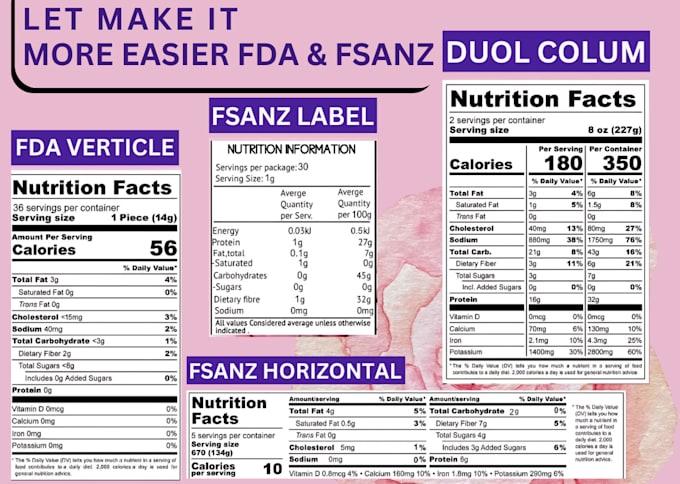
2. Label Requirements
Australian and US label requirements differ across almost every element:
Your Australian label cannot be used in the US market. A US-specific label must be developed from scratch.
3. Permitted Ingredients and Additives
Not all ingredients approved under the FSANZ Food Standards Code are approved in the US, and vice versa. This is a critical due diligence step before launching.
Common issues:
Certain colourings: Some food colourings permitted in Australia are not GRAS (Generally Recognised As Safe) in the US, or require specific warning labels.
Stevia and novel sweeteners: Generally well-aligned, but specific extract types and usage levels may differ.
Certain herbs and botanicals: Many ingredients common in Australian supplements are not classified as dietary ingredients under DSHEA and cannot be included in a US dietary supplement without a New Dietary Ingredient (NDI) notification.
Caffeine limits: No specific limit under FSANZ; FDA has issued guidance on high-caffeine products and has taken enforcement action against concentrated caffeine products.
Every ingredient in your Australian formulation must be verified for US compliance before you manufacture for the US market.
4. Health Claims and Marketing Claims
This is where Australian brands most commonly get into trouble in the US.
Under FSANZ: Nutrition content claims and health claims are permitted if they meet the requirements of Standard 1.2.7. General level health claims are relatively accessible for compliant products.
Under FDA: Health claims on conventional food are tightly regulated and most require FDA authorisation. Structure/function claims (e.g., "supports immune function") are permitted on dietary supplements without pre-approval, but require:
A disclaimer: "This statement has not been evaluated by the Food and Drug Administration. This product is not intended to diagnose, treat, cure, or prevent any disease."
Notification to FDA within 30 days of first marketing
Substantiation (credible scientific evidence)
Disease claims — any claim that implies your product treats, prevents, or cures a disease — are drug claims under US law, regardless of whether the product is marketed as a supplement. Making a disease claim on a supplement automatically makes it an unapproved drug. This is strictly enforced.
5. Manufacturing Standards: GMP vs cGMP
FSANZ: Requires that food is produced in a way that is safe and suitable. The Food Standards Code references HACCP principles but doesn't mandate a specific GMP framework for most food products.
FDA: Requires that dietary supplements are manufactured under current Good Manufacturing Practice (cGMP) regulations (21 CFR Part 111). These are detailed, prescriptive requirements covering facility design, equipment, personnel, production and process controls, laboratory operations, and record keeping. cGMP compliance is mandatory — not optional — for any dietary supplement sold in the US.
If you're manufacturing in Australia for the US supplement market, your manufacturer must either hold FDA registration and operate to cGMP standards, or you must find a US-based cGMP-compliant manufacturer.
6. FDA Facility Registration
Any facility (including Australian facilities) that manufactures, processes, packs, or holds food for consumption in the US must register with the FDA under the Bioterrorism Act and FSMA. This registration must be renewed every two years.
If your Australian manufacturer is not FDA-registered, your product cannot legally be imported into the US.
Key FDA Requirements for Importing Food Into the US
Beyond product compliance, importing food or supplements into the US requires:
Prior Notice: FDA must be notified before food arrives at a US port. This is typically handled by your US customs broker.
FDA Facility Registration: Your manufacturer must be registered.
FSVP (Foreign Supplier Verification Program): If you're importing into the US, your US importer is required to have an FSVP in place — a documented programme verifying that your foreign supplier is producing food that meets US safety standards. This responsibility sits with the US importer, but you need to be able to support their FSVP with documentation.
Labelling compliance: US Customs can detain or refuse entry to products with non-compliant labels.
Common Mistakes Australian Brands Make Entering the US
Using Australian labels: Your Australian NIP, Australian RDI-based daily values, and Australian allergen format are not compliant in the US. This is the most common and most easily avoided mistake.
Assuming ingredient approval transfers: Just because an ingredient is permitted in Australia doesn't mean it's permitted in the US. NDI issues are a serious risk in the supplement space.
Making disease claims: "Supports healthy cholesterol levels" might be fine in Australia as a general level health claim; in the US, this can be interpreted as a disease claim. Get US regulatory review on all claims before you market.
Using a manufacturer without FDA registration: If your Australian manufacturer isn't FDA-registered, your product cannot legally enter the US.
Ignoring FSVP: If you don't have a US importer with FSVP in place, your product will be held at customs.
The Practical Path for Australian Brands Entering the US
Verify your formulation — check every ingredient against US permitted ingredient lists and GRAS status
Determine your US product category — conventional food or dietary supplement? This determines your label format and claim permissions
Develop a US-specific label — Nutrition Facts or Supplement Facts panel, US allergens, US daily values, required disclaimer
Verify your manufacturer's FDA registration — or identify a US cGMP-compliant manufacturer
Review all claims against FDA standards before you print anything
Identify a US importer and confirm FSVP is in place
Brief a US customs broker on prior notice requirements
How YGF Can Help
YGF Manufacturing supports Australian brands expanding into the US market. We help with formulation review for US compliance, US label development, FDA-registered manufacturer sourcing, and go-to-market strategy for the American market. We've helped Australian food and supplement founders navigate the FSANZ-to-FDA transition without the expensive mistakes.


