
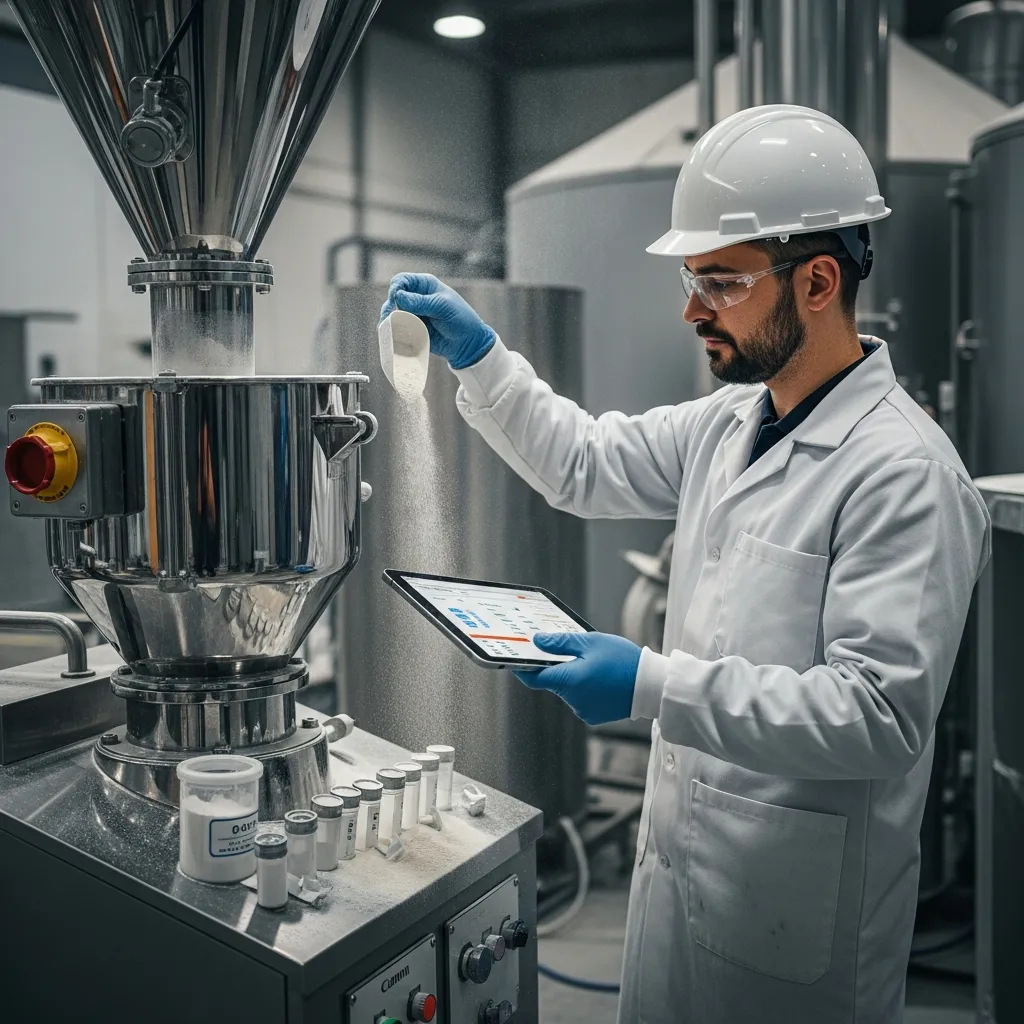
Dry Powder Blend Manufacturing 101: Protein, Pre-Workout & Nutraceutical Powders Explained
One founder had a pre-workout formula he'd been mixing in his garage for two years. Friends loved it. He figured manufacturing would just mean "make more of this, but bigger." He was wrong. Not because the recipe was bad. Because scaling a powder isn't scaling a recipe. It's re-engineering it.
Good news, though. Of every category in food and supplement manufacturing, powders are the friendliest to a first-time founder. Fastest to launch. Lowest entry barrier. Fewest ways to get badly stuck. If you want the bigger picture first, our guide on how food manufacturing works from concept to production covers the full journey.
Here's how the process actually works.
Why Powders Are the Easiest Entry Point
Compare a powder to a gummy or a bar. No cooking step. No moisture to manage. No shelf-stability nightmare from an active ingredient reacting with heat.
A powder blend is, at its core, dry ingredients mixed to a precise ratio. That simplicity is the whole appeal.
It shows up in the numbers too:
Timeline: 3 to 4 months from brief to production, the fastest of any category
MOQ: often as low as 50 to 100kg with the right manufacturer
Packaging flexibility: sachets, tubs, stick packs, pouches, all viable at small scale
If you're testing a market for the first time, powders are usually where smart founders start.
What "Blending" Actually Involves
It sounds simple. Mix ingredients together. In practice, commercial blending is a precision exercise.
Three things separate a good powder manufacturer from a mediocre one:
Particle size matching. If your protein isolate and your flavour powder have different particle sizes, they separate during transport. Customers get an uneven scoop every time.
Uniform distribution. Active ingredients need to be evenly spread through the entire batch, not clustered near the top or bottom of the blender.
Static and dust control. Fine powders like creatine or electrolyte blends behave differently under industrial mixing than they do in a home blender.
None of this shows up in a taste test. It shows up three months later, in a customer complaint about inconsistent scoops.
Flavour Masking: The Problem Nobody Warns You About
This is where most powder projects hit their first real wall.
Protein, in particular, tastes chalky and slightly bitter on its own. Whey isolate, pea protein, collagen all need flavour masking to be genuinely enjoyable. Not just sweetened. Masked.
Good flavour houses use bitter blockers and mouthfeel agents, not just sugar or sweetener, to solve this. It's a real skill, and it's usually the difference between a powder that tastes like a supplement and one that tastes like a treat.
Expect at least two to three rounds of flavour iteration before you land on something worth putting your name on.
Packaging Choices That Actually Matter
Powder packaging isn't just a branding decision. It affects shelf life directly.
●Foil-lined pouches protect against moisture and light, ideal for hygroscopic ingredients like electrolytes.
●Rigid tubs are easier for consumers to scoop from but cost more per unit at low volume.
●Stick packs work well for single-serve, travel-friendly positioning, but add packaging cost per gram.
Moisture is the enemy here. A powder that clumps in the tub within a month usually points to a packaging barrier issue, not a formulation one.
How MOQ Actually Works for Powders
This is the part that surprises most founders in a good way.
Powder blends can often start from as low as 50 to 100kg. Depending on your serving size, that's a genuinely testable first run, not a warehouse full of unsold stock. Compare that to bars, which often start around 5,000 units, or drinks, which typically need higher minimum runs.
That lower entry point is exactly why powders are the category most founders use to validate demand before committing bigger budgets to a bar, gummy, or drink line.
A Simple Path From Recipe to Shelf
Lock your formulation. Nail the active dosing and the base blend before chasing flavour perfection.
Solve flavour masking. Budget real time for this. It's rarely a one-shot process.
Match to the right manufacturer. Not every blender handles fine actives like magnesium bisglycinate or creatine well. Ask about their equipment.
Run a trial batch. Test blend uniformity and packaging performance before committing to a full run.
Finalise compliance. FSANZ labelling, nutrition panels, and any structure/function claims need sign-off in parallel with production.
Simple on paper. Still worth doing in order, because skipping formulation to chase a fast launch usually means reformulating later anyway.
Where This Usually Goes Wrong
Founders who skip flavour testing launch a powder that tastes fine to them and gets returned by everyone else. Founders who skip particle-size matching launch a powder that separates in transit and looks unprofessional on unboxing. Founders who pick a manufacturer based on price alone, without checking their minimum batch precision, end up with inconsistent dosing between production runs.
All avoidable. None of it obvious until you've been through it once.
His pre-workout eventually launched, after two flavour reformulations and switching manufacturers once when the first blender couldn't handle his electrolyte load without clumping. Four and a half months, start to finish. Close to the fastest possible timeline for the category.
If you've got a powder recipe that works in your kitchen and you're wondering what it takes to get it onto a shelf, that's exactly the conversation to have early, not after you've committed to a supplier. YGF Manufacturing has helped 200+ founders scale powder formulations through FSANZ-compliant manufacturers matched to their actual batch size. Take a look at our dry powder blend manufacturing services, or book a free discovery call and let's map out what your product needs.


