
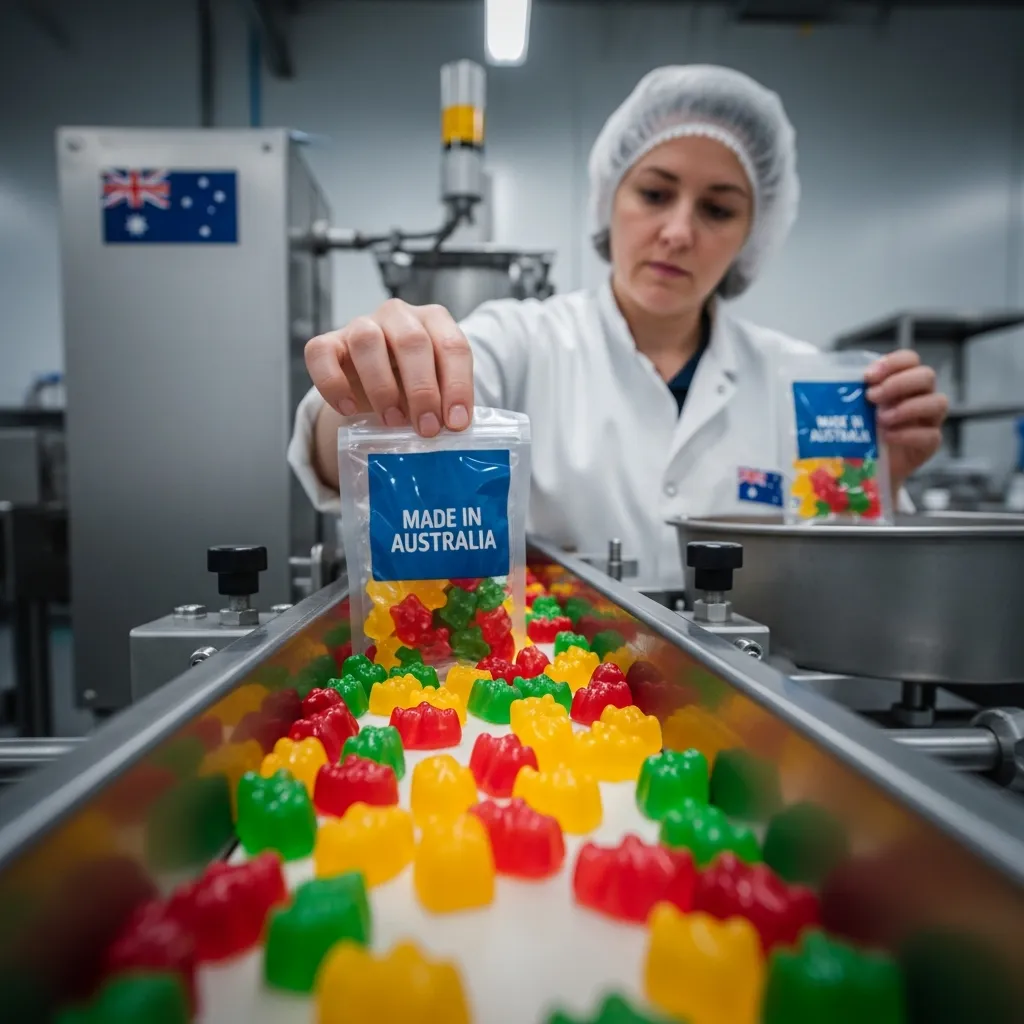
How Gummies Are Manufactured in Australia: MOQs, Timelines & Real Costs
So you want to launch a gummy. Good instinct. Gummies are one of the fastest-growing formats in food and supplements right now, and for good reason, people actually enjoy taking them. But “I want to make a gummy” and “I understand how gummies get made” are two very different sentences. Let’s close that gap.
What Actually Happens When a Gummy Gets Made
Forget the jelly-and-mould kitchen experiment for a second. Commercial gummy production runs through four core stages, and each one has its own quirks.
First, formulation. This is where your recipe gets turned into something that can survive a production line without falling apart, going cloudy, or tasting like chemistry class. Active ingredients (if you’re doing a functional gummy) need to be dosed accurately and stay stable through heat and setting time. Flavour and colour need to hold up too, not just on day one, but on day ninety sitting in a warehouse.
Then comes moulding or depositing. Liquid gummy mixture gets deposited into moulds (usually starch or silicone) at high speed and high volume. This is not a hand-pouring situation. It’s mechanical, precise, and unforgiving of a formulation that’s slightly off.
Curing is next. Gummies need time to set properly, develop the right chew, and stabilise. Rush this and you get gummies that stick together in the bag or lose their shape in transit. Nobody wants a bag of gummy soup.
Last, packaging. Gummies are sensitive to humidity and temperature, so packaging isn’t just branding, it’s protection. Get it wrong and your product degrades before it even reaches a shelf.
Realistic MOQs (And Why They’re All Over the Place)
Here’s the question everyone asks first: how many do I actually need to order? For gummies in Australia, minimum order quantities typically start from around 1,000 units, though this shifts depending on your manufacturer, your formulation complexity, and whether you’re using a stock shape or something custom.
Why the range? A few reasons. Custom moulds cost money to produce, so a bespoke gummy shape pushes your MOQ and your setup cost up. A functional gummy with active ingredients often needs more testing and more careful batching than a plain fruit gummy, which can also shift minimums. And manufacturers themselves vary wildly, some are built for big established brands only, others are genuinely set up to work with a founder placing their first order.
The mistake we see constantly? Founders assume a lower MOQ is always the better deal. Sometimes it is. Sometimes a slightly higher MOQ with a manufacturer who actually understands your category saves you a failed batch down the line. Cheap and wrong costs more than modest and right.
The Timeline: What’s Actually Eating Your Time
Plan for four to five months from a locked formulation to a finished, packaged product. That’s not us being cautious, that’s just how long it genuinely takes to do this properly.
Roughly, it breaks down like this: formulation and sample rounds eat the first four to six weeks, sometimes longer if your flavour or dosing needs several iterations (and it usually does, taste is subjective and hard to nail first try). Manufacturer trial runs and scale-up validation take another few weeks. Then full production, quality checks, and packaging round things out.
Packaging development runs in parallel, which helps, but it still adds its own four to six weeks on top if you’re doing custom printed pouches or bespoke jars rather than stock options.
FSANZ Compliance: The Bit Founders Skip Until It Bites Them
Gummies sold in Australia need to meet FSANZ standards, and if you’re making functional or supplement-style gummies, TGA considerations can come into play too. This covers everything from ingredient permissibility (not every active is approved for use in a confectionery format) to labelling accuracy, nutritional panels, and any claims you put on the pack.
Here’s the thing about compliance: it’s not a final step you tack on before launch. It shapes your formulation from day one. An ingredient that’s perfectly legal in a capsule might not be approved at the dose or delivery method you want in a gummy. Founders who bring compliance into the formulation conversation early save themselves a painful, expensive reformulation later.
Three Mistakes We See Founders Make Before Production Even Starts
Locking in flavour and colour too early. Gummies change subtly through the curing and packaging process. What tastes perfect in a small hand-mixed sample can shift slightly once it’s run through commercial equipment. Leave room to adjust.
Underestimating shelf-life testing. A gummy that tastes great on day one but goes hard, sticky, or bland by month three is a returns problem waiting to happen. Real shelf-life testing takes time, and skipping it is one of the more common (and costly) shortcuts founders try to take.
Choosing a manufacturer before the formulation is finalised. This one trips up a lot of first-timers. Lock in a manufacturer too early and you might find out later they can’t actually produce your specific formulation at the volume, texture, or price point you need. Formulation first, manufacturer match second, always.
Ingredients That Play Nice (And Ones That Don’t)
Not every ingredient behaves well in a gummy matrix. Pectin-based and gelatin-based gummies set differently, absorb flavour differently, and have different vegan/halal/kosher implications depending on your target market. Acidic ingredients can interfere with setting time. Some active ingredients taste genuinely awful and need masking agents that can shift your whole flavour profile. None of this is a reason to avoid gummies. It’s a reason to loop in someone who’s solved these problems before, rather than discovering them one failed batch at a time.
Colour is its own small minefield too. Natural colourants (from fruit and vegetable extracts) tend to fade or shift over shelf life more than synthetic ones. If “clean label” matters to your brand, and increasingly it does to consumers, budget extra sampling time to get a natural colour that still looks appetising six months after production, not just on day one.
What This Actually Costs
Founders love a straight answer here, and the honest one is: it depends, but here’s a way to think about it. Take a comparable gummy already on shelf in your category, and divide its retail price by three to five. That’s a rough production cost target to aim for. Ingredient cost (especially for functional actives), custom mould tooling, and packaging complexity all push that number around, sometimes significantly. A plain vitamin gummy in a stock shape costs a lot less to produce than a novel functional blend in a custom mould with premium packaging. Know which one you’re actually building before you get attached to a retail price point.
Where This Fits Into Your Bigger Launch
Gummies are just one format among several, and honestly, they’re not the right call for every product idea. If you’re still weighing up gummies against protein bars, powders, or drinks, it’s worth stepping back and reading through our broader guide on how food manufacturing actually works from concept to production before you commit to a format.
At YGF Manufacturing, gummies are one of our most requested categories precisely because founders underestimate how technical they are until they’re halfway into a formulation. We handle the formulation, manufacturer matching, compliance and production oversight so you’re not learning all of this the hard way, mid-production, with stock already ordered.
Got questions about your specific gummy idea, dosing, MOQ, timeline, budget? Check our FAQs for the quick answers, or skip straight to the good part.
Ready to take the next step? Here is what you should do next: book a free discovery call and let’s talk through what your gummy actually needs to get from idea to shelf.


