
How to Manufacture Gummy Products in Australia: A Founder's Guide to MOQs, Costs & Compliance
A founder we spoke with recently spent three months perfecting a gummy recipe on her kitchen stove. Magnesium, a hint of passionfruit, the texture just right. She was proud of it. Then she called a manufacturer.
"What's your MOQ?"
She didn't know what that meant.
"What's your FSANZ classification, therapeutic or food-standard?"
She didn't know that either.
Two calls later, she was more confused than when she started. This happens to almost every founder who tries to turn a gummy recipe into a real product. The category looks simple from the outside. Chewy. Fun. A bit of fruit puree and gelatin. On the inside, it's one of the more technical categories in food manufacturing. For a broader look at how the whole production journey works, our guide on how food manufacturing works from concept to production is a good place to start.
Here's what you actually need to know.
Why Gummies Are Deceptively Hard to Manufacture
A kitchen recipe and a commercial-scale recipe are not the same thing. Not even close.
Home gummies set in a mould overnight. Commercial gummies need to survive a depositing line, a drying tunnel, oiling or sugar-coating, and months in a warehouse without going soft, sweating, or losing potency. That's a different formulation problem entirely.
Three things change everything once you scale up:
Gelling agent behaviour. Gelatin and pectin react differently to heat, pH, and active ingredients like vitamin C or magnesium.
Active ingredient stability. Many actives degrade in a warm, moist gummy matrix. Your dose on day one might not be your dose on day 180.
Shelf life under real conditions. A fridge-stored prototype tells you nothing about a gummy sitting in a Queensland warehouse in January.
This is why founders who go straight to a factory with a kitchen recipe often get told to start over.
The Two Regulatory Paths (And Why This Trips Everyone Up)
In Australia, gummies fall into one of two very different regulatory buckets.
Food-standard gummies sit under FSANZ as a confectionery item. Simpler process. Fewer claims allowed.
Therapeutic gummies are anything making a health claim, or containing certain actives at certain doses, and can fall under TGA territory instead.
Get this classification wrong early, and you'll redo your formulation, your packaging, and your claims. Sometimes all three. Get it right early, and it barely slows you down.
This single decision shapes your ingredient list, your labelling, and even which manufacturers can produce for you. It's not a step to guess at.
What MOQs Actually Look Like
Minimum order quantities scare a lot of first-time founders away from gummies. They shouldn't.
Gummy MOQs can start as low as 1,000 units with the right manufacturing partner. Not every factory offers that. Big commercial gummy lines are often built for orders in the hundreds of thousands. But a growing number of manufacturers specialise in smaller, startup-friendly runs.
The trick is knowing which manufacturers fit your stage. A factory built for Coles-scale orders will either reject a small brief or price it so high it doesn't make sense.
The Realistic Timeline
Gummies are not a fast product. Anyone who tells you otherwise is skipping a step.
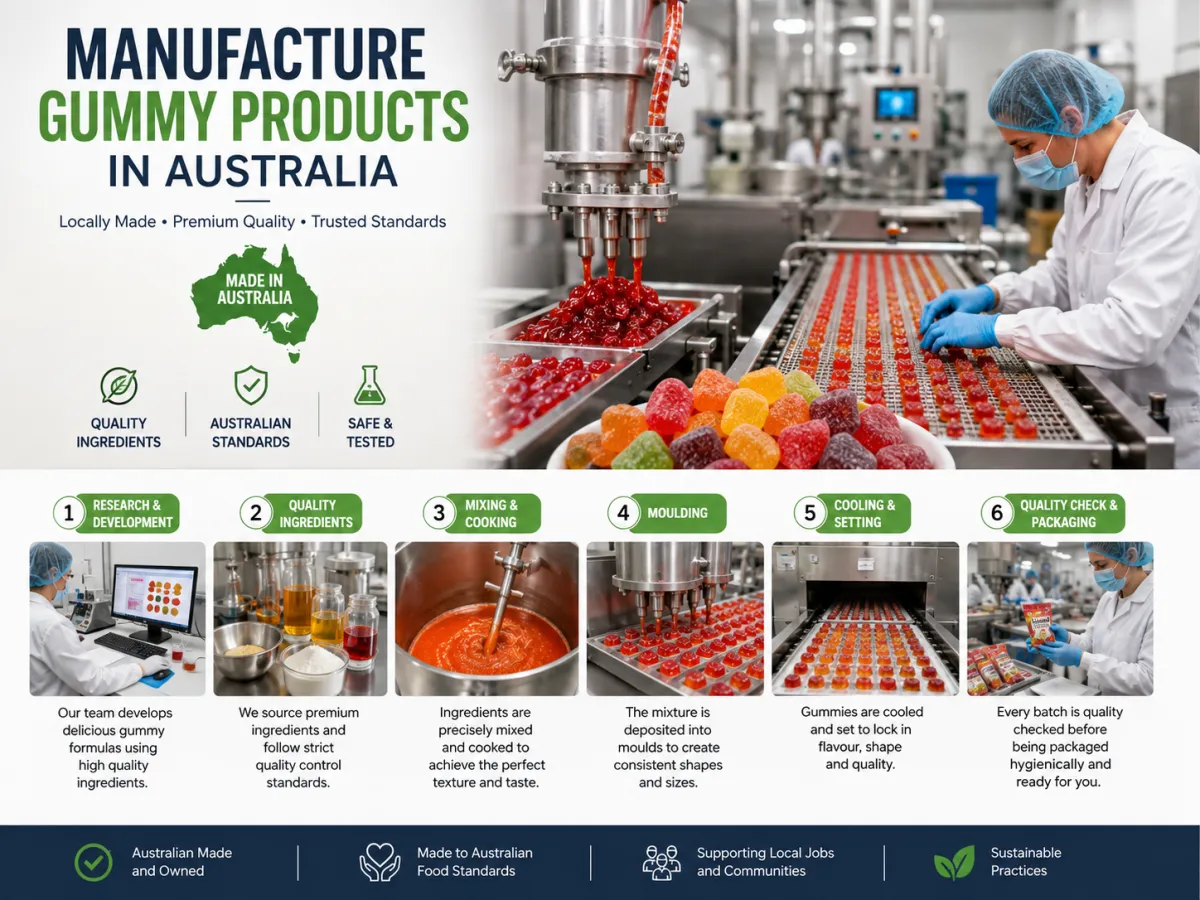
Expect somewhere between five and seven months from brief to first production run. That covers:
Formulation and flavour development
Stability and shelf-life testing
Manufacturer selection and trial batches
Client sign-off before commercial production
Packaging and compliance finalisation
It's slower than a powder. It's faster than most people fear, once the process is structured properly.
What Actually Drives Cost
Founders often ask for a number before they've picked ingredients. Fair enough, but it doesn't work that way.
Cost is shaped by:
The active ingredients used and their dose
Whether the product needs TGA-aligned manufacturing
Coating type (sugar dusting vs oil finish)
Packaging format (pouch vs bottle vs blister)
Order volume
A rough industry rule: look at what similar products retail for, then divide by three to five. That gives a workable target cost. Your actual number moves depending on formulation choices.
A Few Formulation Traps Worth Knowing About
Not all gummy problems show up on day one. Some show up in month three, after your first batch has shipped.
Sugar migration. Poorly formulated gummies can develop a gritty, crystallised surface over time.
Moisture loss. Gummies stored in the wrong packaging dry out and go tough.
Active clumping. Higher-dose actives like magnesium can settle unevenly during depositing if the viscosity isn't right.
None of these are dealbreakers. They're just reasons formulation and packaging need to be designed together, not bolted on separately at the end.
So Where Do You Actually Start?
Most founders start in the wrong place. They chase a factory before they've nailed a formulation, or they nail a formulation that no factory can scale. Both routes waste months.
The order that actually works:
Lock in your target claims and classification (food or therapeutic)
Develop and test the formulation for commercial stability
Match to a manufacturer whose MOQ and equipment suit your stage
Run a trial batch before committing to full production
Finalise packaging and compliance documentation in parallel
Skip step one, and everything after it is built on sand.
She eventually got her magnesium gummy to shelf. It took reformulating twice, a proper stability test, and finding a manufacturer who actually worked with startup volumes. Nine months from idea to launch. Slower than she wanted. Faster than most.
If you're sitting where she was, staring at a kitchen recipe and a list of questions you can't answer yet, you don't need to figure this out alone. YGF Manufacturing has taken 200+ founders through exactly this process, from formulation through to FSANZ and TGA-aligned production with manufacturers matched to your actual volume. Explore our gummy manufacturing services or read our complete guide to gummy manufacturing in Australia for a deeper dive into the process. Book a free discovery call and let's work out what your gummy actually needs to get to shelf.


